The Scoville Scale Explained: What Those Numbers on Your Hot Sauce Actually Mean
The first time someone tries our Kangaroo Kick Hot Sauce (/products/slug/kangaroo-kick-hot-sauce) — rated 9.5 out of 10 on our heat scale, with 272 community ratings averaging 9.64 — there's a predictable sequence of events. A confident dab on the spoon. A brief pause. Then the slow-building wave of ghost-pepper-level heat that turns a sceptic into a believer. But what does "9.5 out of 10" actually measure? And how did a pharmacist from Connecticut figure out, more than a century ago, how to put a number on the sensation of eating fire?
Welcome to the Scoville scale — the standard measurement behind every "how hot is this?" conversation you've ever had over a bottle of sauce.
How Wilbur Scoville Put a Number on Heat
In 1912, American pharmacist Wilbur Scoville was working at the Parke-Davis pharmaceutical company and needed a reliable way to measure the pungency of chilli peppers. His method was elegantly simple: dissolve a precise weight of dried pepper in alcohol to extract the capsaicinoids (the compounds responsible for the burn), then dilute that extract in sugar water. A panel of five trained tasters would sample increasingly diluted versions until at least three of them could no longer detect any heat.
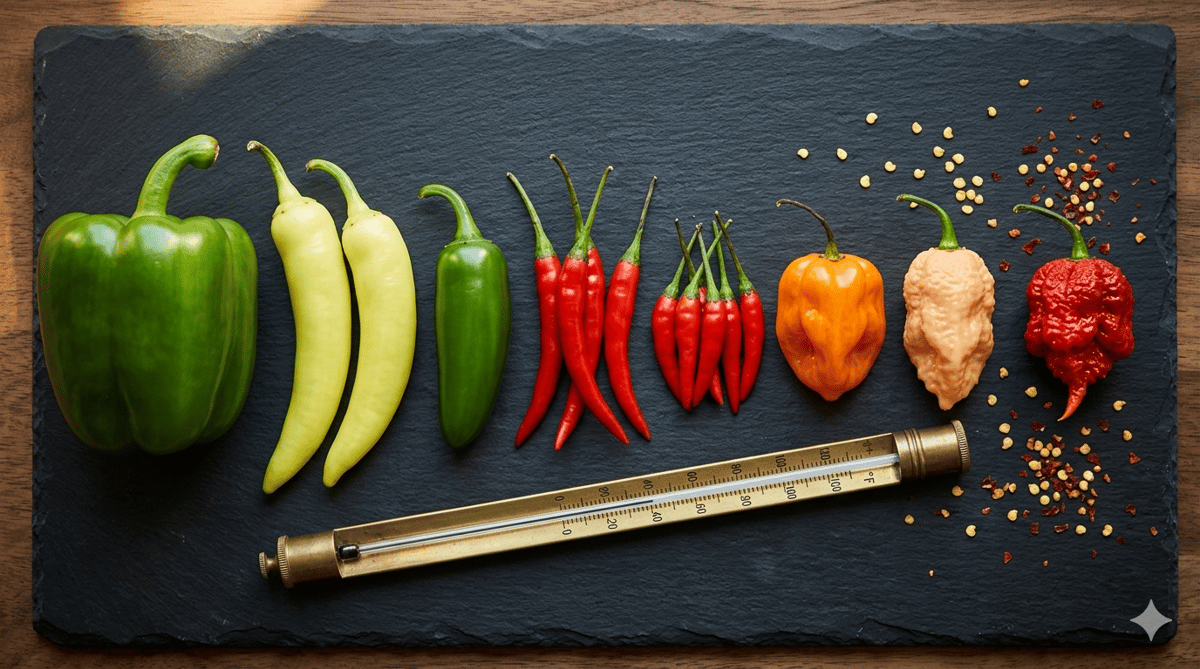
The number of dilutions required became the pepper's Scoville Heat Unit (SHU) rating. A bell pepper, with zero capsaicin, scores 0 SHU. A jalapeno sits between 2,500 and 8,000 SHU. And the current Guinness World Record holder, Pepper X — cultivated by Ed Currie at the PuckerButt Pepper Company in South Carolina — clocks in at a staggering 2,693,000 SHU.
The original test had a charming flaw: it relied entirely on human tongues. Results could vary by up to 50% between laboratories, depending on the tasters' sensitivity and how many capsaicin receptors they happened to be born with. A bold method for 1912, but science eventually caught up.
The Modern Method: HPLC and Why It Matters
Today, the gold standard for measuring hot sauce heat levels is High-Performance Liquid Chromatography, or HPLC. Rather than relying on a panel of increasingly sweaty volunteers, HPLC uses analytical chemistry to identify and quantify the exact concentration of capsaicin and its close relative, dihydrocapsaicin, in a dried sample dissolved in acetonitrile.
The process traces the peak areas of these capsaicinoids, applies a conversion formula (the combined peak values, multiplied by 15), and produces a precise SHU number. It's more expensive than the organoleptic test, but it removes the subjectivity entirely. It also reveals something the original Scoville test couldn't: the individual capsaicinoid profile of each pepper or sauce. That profile is what separates a sharp, immediate burn from a slow, creeping heat that builds over thirty seconds — a distinction any serious hot sauce maker pays close attention to.
Where the Sauces Actually Sit
Understanding Scoville ratings is one thing. Feeling them is another. Here's a rough guide to how different heat levels translate on the tongue:
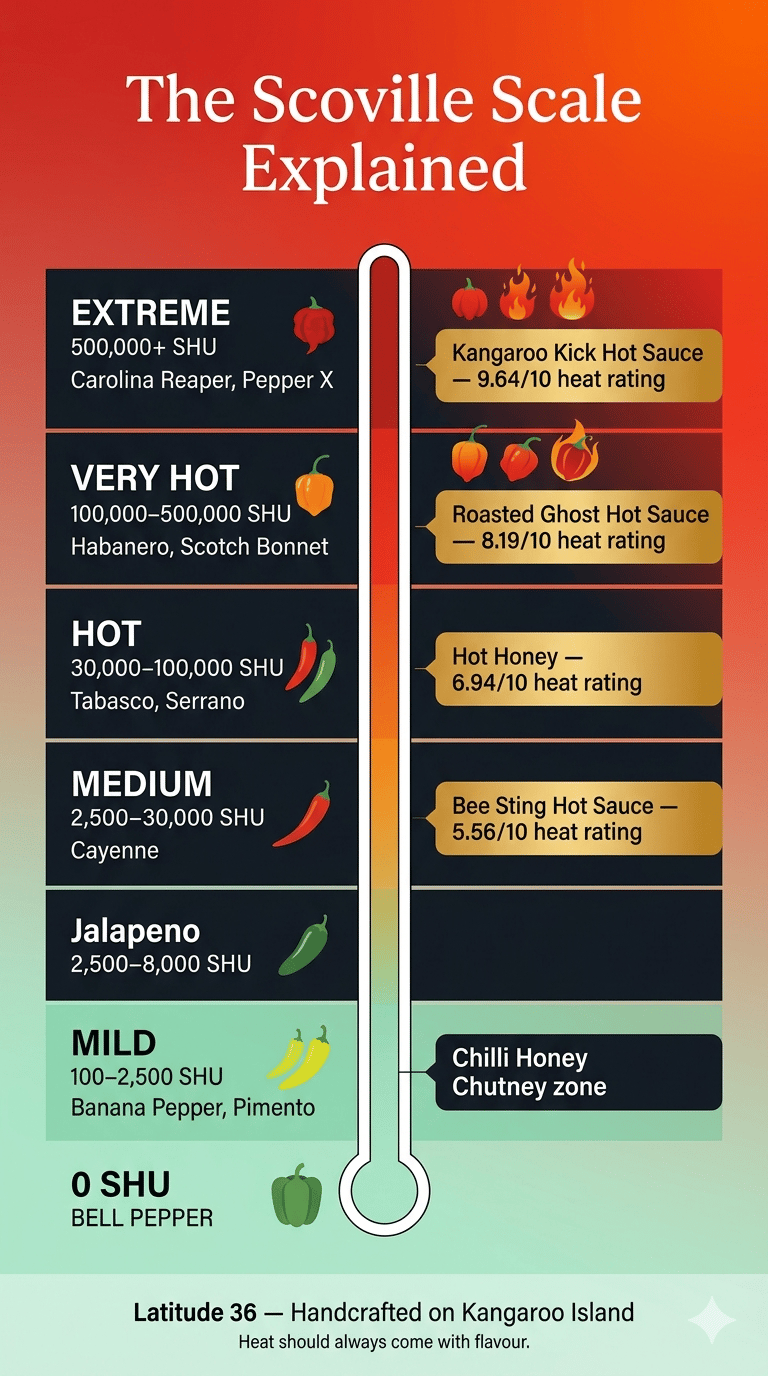
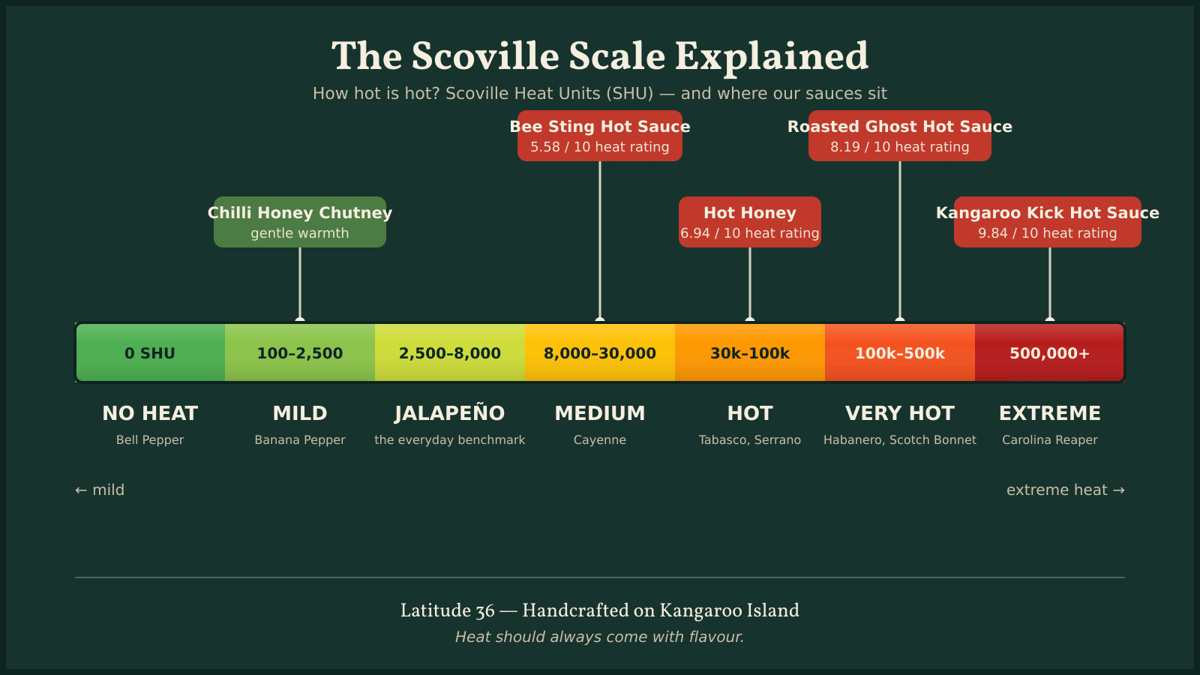
Mild (100–2,500 SHU): A gentle warmth. Think banana peppers or a mild pimento. You'll notice the heat exists, but it won't interrupt your conversation. Our Chilli Honey Chutney lives in this territory — enough heat to make the honey sing without overwhelming it.
Medium (2,500–30,000 SHU): The jalapeno to cayenne range. This is where flavour and heat start dancing together in earnest. Our Bee Sting Hot Sauce (/products/slug/bee-sting-hot-sauce), with a community heat rating of 5.56/10 from 72 ratings, sits comfortably here — enough kick to elevate a taco or a marinade, but still friendly enough for a weeknight dinner.
Hot (30,000–100,000 SHU): Tabasco and serrano territory. You're going to feel this one. Our Hot Honey (/products/slug/hot-honey) at 6.94/10 (125 ratings) delivers that "spicy-sweet" combination that's taken charcuterie boards and pizza by storm — the heat arrives after the floral honey sweetness, and the two chase each other across your palate.
Very Hot (100,000–500,000 SHU): Habanero and Scotch Bonnet country. The burn is immediate and persistent. The Roasted Ghost Hot Sauce (/products/slug/roasted-ghost-hot-sauce) at 8.19/10 (37 ratings) enters this territory — the ghost peppers (Bhut Jolokia, over 1,000,000 SHU on their own) are first roasted in our wood-fired oven on Kangaroo Island, which adds a smoky depth beneath the searing heat.
Extreme (500,000+ SHU): The realm of Carolina Reapers and Pepper X. Our Kangaroo Kick at 9.64/10 average from 272 community ratings is handcrafted for heat seekers who refuse to sacrifice flavour for fire. A few drops transform a dish. A few more — that's between you and your sweat glands.
Why the Number on the Bottle Isn't the Whole Story
Here's what Scoville ratings don't tell you: how the heat behaves. Two sauces with identical SHU can feel completely different depending on their capsaicinoid profile, the other ingredients in the recipe, and whether the peppers were used raw, dried, smoked, or — as we do with our Ghost Hot Sauce — roasted in a wood-fired oven.
Roasting transforms capsaicin's sharp attack into something rounder, deeper. The sugars in the pepper caramelise. The smoky char adds a savoury dimension that pure extract-based sauces never achieve. This is why craft hot sauces made from whole peppers taste fundamentally different from sauces that achieve their heat by adding capsaicin extract — a distinction the Scoville number alone can't capture.
A 2023 USDA study found that 68% of shoppers couldn't differentiate between "medium" and "hot" labels on store shelves. The Scoville scale gives you a starting point, but finding your actual preference means tasting — carefully, incrementally, and with a glass of milk nearby.
Finding Your Heat
The honest truth about heat tolerance: it's trainable. Capsaicin triggers your TRPV1 pain receptors, and repeated exposure gradually desensitises them. Regular hot sauce users genuinely handle more heat than occasional dabblers — it's not bravado, it's biology.
Start where you're comfortable. If you're new to heat, a chilli-infused honey or a mild chutney lets you explore the flavour side of chillies without the endurance test. If you've been chasing heat for years and your friends have stopped accepting dinner invitations, something like Kangaroo Kick exists specifically for you.
Written by the team at Latitude 36, a 4th-generation family farm on Kangaroo Island, South Australia.
Every sauce in our range is handcrafted on Kangaroo Island with no artificial preservatives — just peppers, time, and a fourth-generation farming family's conviction that heat should always come with flavour. For the full story behind our hottest creation, read Kangaroo Kick Hot Sauce: The Fiery Legend Born on Kangaroo Island (/blog/kangaroo-kick-hot-sauce-fiery-legend).